CHAPTER - 06 MOLECULAR BASIS OF INHERITANCE - Class 12 Biology
CHAPTER- 06 MOLECULAR BASIS OF INHERITANCE
DNA (Deoxyribonucleic Acid) and RNA (Ribonucleic Acid) are two types of nucleic acid found in living organisms. DNA acts as genetic material in most of the organisms. RNA also acts as genetic material in some organisms as in some viruses and acts as messenger. It functions as adapter, structural, and in some cases as a catalytic molecule.
The DNA - it is a long polymer of deoxyribonucleotides. A pair of nucleotide is also known as base pairs. Length of DNA is usually defined as number of nucleotides present in it. Escherichia coli have 4.6 x 10⁶ bp and haploid content of human DNA is 3.3 × 10⁹ bp.
Structure of Polynucleotide Chain
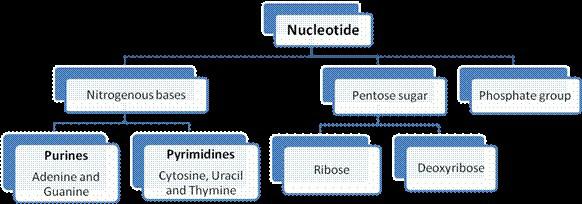

Structure differences
| DNA | RNA |
|---|---|
| The sugarpresent in DNA is 2-deoxy-D - (- ) -ribose. | Thesugar present in RNAis D- (-)- ribose. |
| DNA contains cytosine and thymine as pyrimidine bases and guanine and adenine is purine bases. | RNA contains cytosine and uracilpyrimidine bones and guanine and adenine as purine bases |
| DNA has double strand α-helix structure. | RNA has a single stranded α-helix structure. |
| DNA molecules are very large their molecular mass may vary from 6✕ 106 - 16 ✕ 106 u | RNA molecules are comparatively much smaller with molecular mass ranging from 20,000 – 40,000 |
| DNA | RNA |
|---|---|
| DNA has uniqueproperty of replication. | RNA usually does not replicate. |
| RNA controls the transmission of hereditary effects. | RNA controls the synthesis of proteins. |


- Single nucleosome contains about 200 base pairs. Chromatin is the repeating unit of nucleosome.

- In nucleus, some region of chromatin are loosely packed (and stains light) and are referred to as euchromatin. The chromatin that is more densely packed and stains dark are called as Heterochromatin. Euchromatin is transcriptionally active chromatin, whereas heterochromatin is inactive.
The search for Genetic Material
Transforming principle – Frederick Griffith in 1928 conducted experiment on bacteria Streptococcus pneumoniae (bacterium responsible for pneumonia). There are two types of strain of this bacteria, some produce smooth shiny colonies (S) and others produce rough colonies(R). Mice infected with the S strain (virulent) die from pneumonia infection but mice infected with the R strain do not develop pneumonia.
S strain → Inject into mice → Mice die
S strain (heat-killed) → Inject into mice → Mice live
S strain (heat-killed) + R strain (live) → Inject into mice → Mice die
Griffith concluded that R strain bacteria have somehow transformed by heat killed S strain bacteria. Some transforming principles transferred from S strain to R strain and enabled the R strain to synthesise a smooth polysaccharide coat and become virulent. This must be due to the transfer of the genetic material.
Biochemical Characterisation of Transforming Principle
-
Oswald Avery, Colin MacLeod and Maclyn McCarty worked out to
determine the biochemical nature of transforming principle of
Griffith.

- They purified biochemicals (proteins, DNA, RNA, etc.) from the heat-killed S cells to see which ones could transform live R cells into S cells. They discovered that DNA alone from S bacteria caused R bacteria to become transformed.So, they concluded that DNA is the genetic material.
Experimental proof that DNA is the genetic material
Alfred Hershey and Martha Chases (1952) worked with virus that infect bacteria called bacteriophages.
-
In one preparation, the protein part was made radioactive and in
the other, nucleic acid (DNA) was made radioactive. These two phage
preparations were allowed to infect the culture of E.coli. Soon
after infection, before lysis of cells, the E.coli cells were gently
agitated in a blender, to loosen the adhering phage particles and
the culture was centrifuged.
-
The heavier infected bacterial cells pelleted to the bottom and the
lighter viral particles were present in the supernatant. It was
found that when bacteriophage containing radioactive DNA was used to
infect E.coli, the pellet contained radioactivity.
- If bacteriophage containing radioactive protein coat was used to infect E.coli, the supernatant contained most of the radioactivity.
His experiment shows that protine does not enter the bacterial cell and only DNA is the genetic material.
